
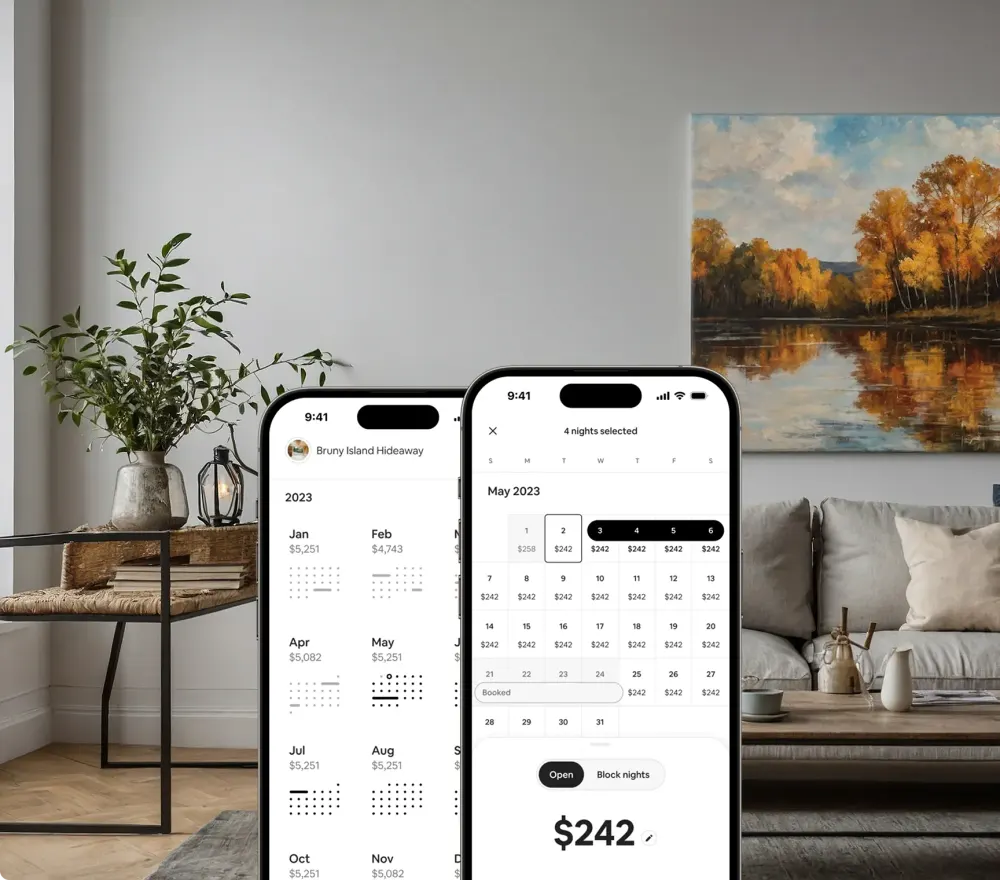
A useful holiday home pricing strategy compares the total guest price with the owner's income after costs. Start with available dates, realistic stay lengths and a clear minimum acceptable result. Then test rate changes against bookings and expenses. A higher advertised nightly rate does not necessarily produce more income.
Editorial check: Reviewed 14 September 2026. Prices, schedules, availability, menus, building access and booking terms can change. Verify live details with the official sources before deciding.
What price should you compare?
Compare the same dates, guest count, stay length, cancellation conditions and included amenities. Record mandatory charges and discounts rather than comparing only the first nightly price shown. A three night stay with an additional cleaning charge can have a different total price from another listing with a higher nightly rate and fewer extras.
Airbnb's service fee explanation distinguishes fee structures that affect guest totals and host payouts. Use the structure that applies to the actual account. A management commission is another charge with its own contractual base; do not assume that it replaces the booking platform's fee.
How can two rates produce the same revenue?
In a purely illustrative month, 20 booked nights at AED 700 and 25 booked nights at AED 560 both produce AED 14,000 of accommodation revenue. The second option is not automatically better or worse. It may involve a different number of turnovers, supply costs, guest needs or calendar gaps.
| Scenario | Booked nights | Rate | Gross accommodation revenue |
|---|---|---|---|
| Higher rate | 20 | AED 700 | AED 14,000 |
| More occupied nights | 25 | AED 560 | AED 14,000 |
| Weaker demand | 15 | AED 600 | AED 9,000 |
These figures are arithmetic examples, not observed Dubai market rates. Calculate the operating balance for each scenario with your own costs. The seasonality guide shows how to keep those assumptions visible.
How does stay length affect pricing?
Ten two night reservations create ten departures; two ten night reservations create two. Both sell 20 nights, but the cleaning workload can differ substantially. Longer stays may introduce other needs, such as scheduled cleaning or supply replacement. State what is included before applying a length of stay discount.
Consider calendar gaps as well. A minimum stay setting can leave a short unsold gap between confirmed reservations. Review the operational cost of filling that gap, including whether there is enough time to prepare the home. A booking that cannot be served well is not a useful pricing win.

Check which settings actually control the price
For a sample set of dates, compare the guest’s checkout total with the host’s payout breakdown using the actual Airbnb fee structure. Hosts using property management software are among those subject to Airbnb’s single fee structure; do not assume the split fee applies. Keep the management commission separate and show Tourism Dirham as its own item using the DET guidance, not as extra owner revenue.
Check automation before testing a discount. Airbnb says Smart Pricing overrides rule sets. Record which system controls nightly prices, discounts and availability, and preview the resulting reservation rather than assuming a saved rule took effect.
Agree who may change base rates, minimum stays, discounts, cancellation settings and owner blocks, including when approval is needed. Keep a dated change log with the affected dates and reason. Compare equivalent booking windows and disclose simultaneous changes; a higher booking count alone does not prove that the pricing decision caused it.
What should a pricing review record?
- The dates and number of nights available, including owner blocks.
- Lead time, booked nights and realized accommodation rate for comparable periods.
- The guest's total price and the owner's expected deductions.
- Changes to minimum stays, discounts or cancellation terms.
- The reason for the change and when its result will be reviewed.
Change a small number of variables so the result remains interpretable. If photographs, rates and cancellation terms change at once, a later increase in bookings cannot be attributed to pricing alone. Record that uncertainty instead of presenting a correlation as a proven cause.
Should a manager use a fixed minimum rate?
A minimum can be a useful owner control when its assumptions are clear. Discuss whether it applies before or after discounts and platform charges, who may change it and how exceptions are approved. Revisit it if costs or the property's condition change. It should support an operating decision rather than an arbitrary promise of income.
How do you turn this into an owner brief?
Give the manager your personal use dates, the costs you want included and the reporting period you will use. Request an explanation of the downside case as well as the preferred case. Review pricing management, compare management charges and test your numbers in the rental calculator.
How this guide was reviewed
Separate the operating decision into permissions, guest experience, property care, pricing and owner reporting. Record who is responsible for each task and cost. Use the current DET requirements and the written management agreement for the property. Examples in this guide are decision aids, not income or booking guarantees. This editorial review removed date sensitive claims that could not be supported by a current primary source.
Continue exploring Dubai
Pro Photography Tips to Boost Your Airbnb Bookings · Smart Airbnb Hosting Tips for Happy Neighbors.